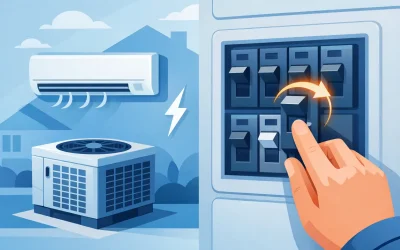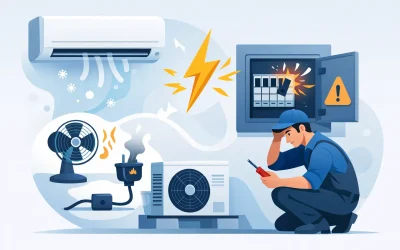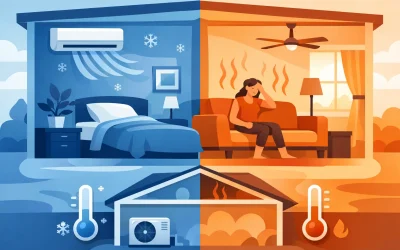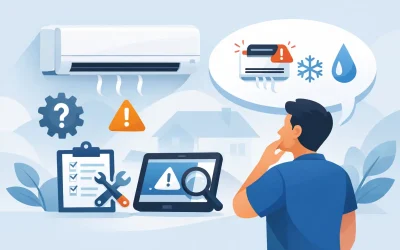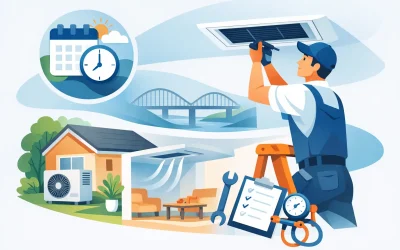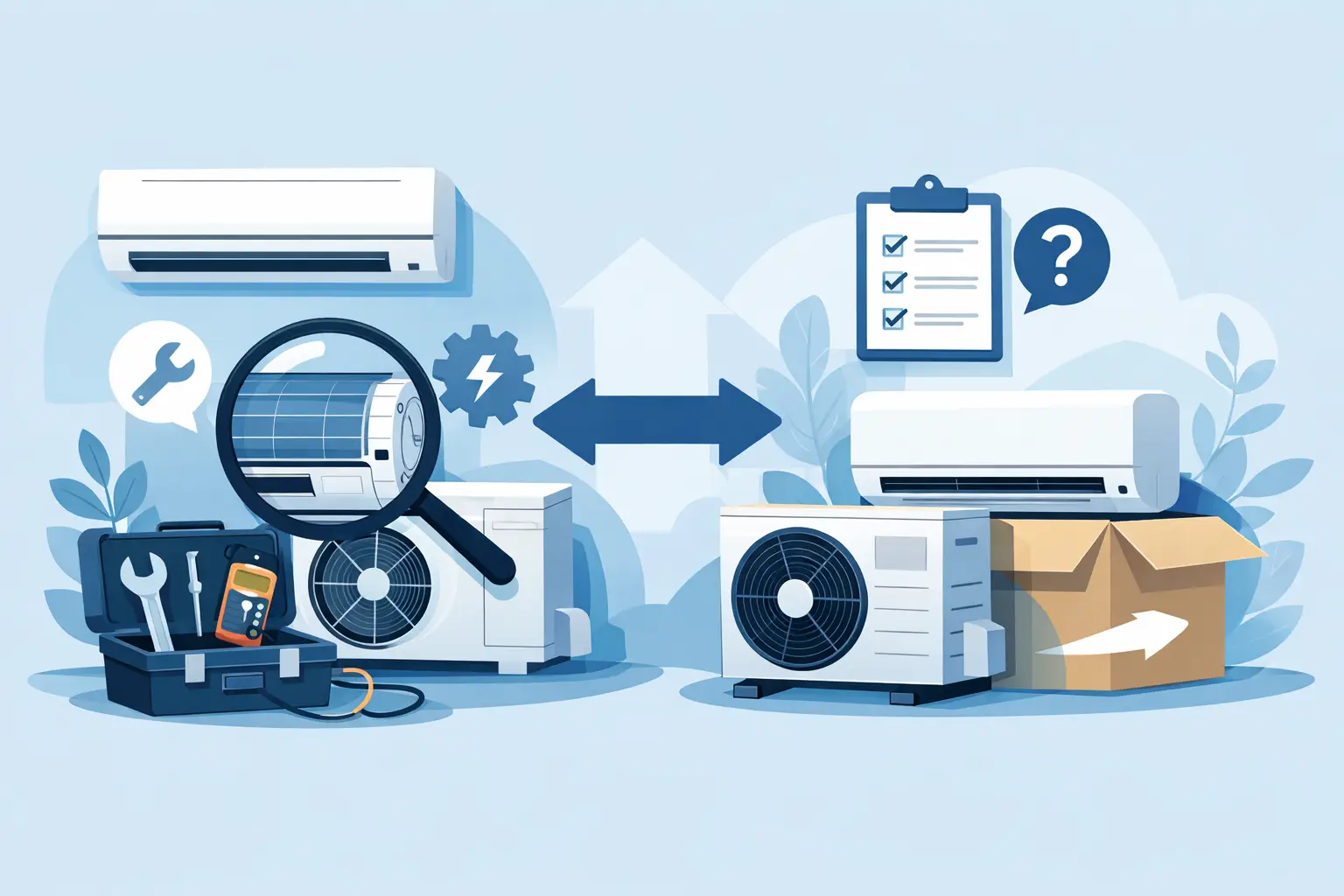
That moment usually comes on the hottest day of the year. The aircon starts blowing warm air, trips the power, leaks water, or simply can’t keep up – and suddenly the question is whether to repair or replace aircon. For Brisbane homes, offices and commercial sites, the right call comes down to more than the fault itself. Age, efficiency, downtime risk and repair history all matter.
A quick repair can absolutely be the smartest option. So can a full replacement. The trouble starts when people make the call based on one quote, one hot afternoon, or the hope that a struggling system will somehow get another few summers in it.
When repair or replace aircon becomes a real decision
Not every breakdown puts you at a crossroads. If a relatively modern unit has a failed capacitor, blocked drain, faulty sensor or worn fan motor, repair is often straightforward and cost-effective. The same goes for systems that have been regularly serviced and otherwise perform well.
The decision gets more serious when faults are recurring, parts are becoming harder to source, or the system no longer suits the space. A ten-year-old split system in a bedroom is one thing. An ageing ducted unit serving a family home, retail tenancy or aged care facility is another. Once reliability starts dropping, the cost of keeping old equipment alive can climb quickly.
For commercial operators, there is also the cost of disruption. Lost trading hours, uncomfortable staff, unhappy customers and emergency callouts can make repeated repairs more expensive than they look on paper.
Start with the age of the system
Age is not the only factor, but it sets the tone for the whole decision.
Most air conditioning systems can deliver solid service for years if they are correctly sized, installed properly and maintained consistently. Even so, there comes a point where wear across compressors, coils, electronics and motors starts stacking up. Once a unit moves into the later stage of its service life, a single repair rarely tells the whole story. You may fix one fault only to expose the next weak point a month later.
As a general guide, if your unit is still relatively young and the fault is isolated, repair is usually worth strong consideration. If it is older and has had multiple issues, replacement often gives better value over the next few years rather than the next few weeks.
This matters even more in Queensland conditions, where long cooling seasons and heavy use put systems under sustained strain.
The repair bill should be judged properly
People often compare the repair cost with the price of a brand-new unit and stop there. That is too narrow.
A better question is what that repair actually buys you. If a moderate repair restores reliable performance for several more years, it may be money well spent. If the same spend only gets an ageing unit limping through one more summer, it is usually false economy.
You also need to factor in likely near-term costs. If the system already has poor airflow, rising power use, noisy operation and uneven temperatures, a single repair may not solve the bigger problem. In those cases, replacement can reduce running costs and avoid repeat callouts.
For commercial sites, there is another layer again: planned replacement is almost always easier than reactive replacement. It gives you time to schedule works, manage tenants or occupants, and avoid a failure at the worst possible time.
Signs repair still makes sense
There are plenty of situations where repairing the unit is the right move.
If the aircon has been dependable up to this point, the fault is clearly diagnosed, and the system is still delivering efficient cooling, repair is often the practical choice. This is especially true where the equipment suits the space and replacement would be premature.
You are generally on safer ground with repair when the issue is minor, parts are readily available, and the unit has a good maintenance history. A well-kept system with one genuine fault is very different from a neglected system with a list of problems.
For homeowners, this can mean getting a few more years out of a split system without overspending. For businesses, it can mean restoring operation quickly while planning future capital works properly rather than rushing into a replacement under pressure.
Signs it is time to replace the aircon
Replacement becomes the stronger option when the system is unreliable, inefficient or no longer fit for purpose.
If you are booking repeated repairs, seeing frequent breakdowns in peak season, or struggling to maintain comfortable temperatures across the space, the aircon is already telling you something. The same applies if parts are obsolete, refrigerant issues are becoming more complicated, or the unit is drawing more power than it should.
Older systems can also fall behind on efficiency. Newer equipment is generally better at maintaining temperature, controlling humidity and managing energy use. For a busy household, that can mean lower running costs and better comfort. For a business, it can mean more stable conditions, less plant stress and fewer interruptions.
Replacement is also worth serious thought when the original system was undersized, oversized or poorly designed. In those cases, repairing the existing unit may restore operation but still leave you with the wrong setup.
Repair or replace aircon for homes
In residential settings, comfort and cost usually drive the decision.
If your bedroom split system stops cooling properly but the rest of the house is fine, a targeted repair may be all you need. If your ducted system is older, struggles in multiple zones and has become expensive to run, replacement may give you a much better result day to day.
Homeowners should also think about how long they plan to stay in the property. If you are settled in for the long term, investing in an efficient new system can make sense sooner. If the property is being prepared for sale or a short hold, a sound repair might be the more practical choice, provided it restores proper performance.
Noise, indoor air quality and humidity control matter too. A system that technically works but leaves rooms clammy, dusty or unevenly cooled is not really doing the job.
Repair or replace aircon for commercial sites
Commercial decisions are less about preference and more about risk, continuity and asset planning.
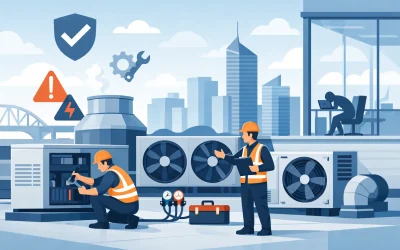
A retail store, school, office or aged care environment cannot always afford to wait and see. If a critical system is ageing and faults are becoming more frequent, replacement may be the safer financial decision because it reduces unplanned downtime. That is especially true where comfort affects operations, compliance or customer experience.
Facility managers should look beyond the immediate fault and review the whole asset. Is the system still meeting the load? Are there known lifecycle issues? Are maintenance costs rising year on year? Can replacement be staged to reduce disruption?
This is where a proper assessment matters. The cheapest short-term fix is not always the best call for the building, the budget or the people using the space.
Energy efficiency changes the maths
Power bills have a way of exposing tired equipment.
Even if an older unit can still be repaired, it may be costing you more every month through inefficient operation. Dirty coils, ageing compressors, poor controls and declining performance all add up. A replacement system may carry a higher upfront cost but improve operating efficiency enough to shift the long-term equation.
That does not mean every older unit should be scrapped. It means efficiency should be part of the conversation, not an afterthought. In many cases, the real comparison is not repair cost versus replacement cost. It is repair cost plus ongoing inefficiency versus replacement cost plus lower operating expense.
Get the diagnosis before making the call
The best decisions start with a proper inspection, not guesswork.
A good technician should be able to tell you what failed, why it failed, whether the repair is likely to hold, and what condition the rest of the system is in. They should also be upfront about whether you are putting good money into a unit that is nearing the end.
That level of honesty matters. A customer-first HVAC team will not push replacement when a repair is the sensible option, and they should not keep patching an unreliable system when a new install would serve you better. That practical approach is exactly what customers expect from a local specialist like Big Dog Mechanical.
If you are weighing up whether to repair or replace aircon, the smartest move is to look at the next few years, not just today’s fault. A solid repair can be the right answer. So can a planned upgrade. The key is choosing the option that gives you reliable comfort, controlled costs and fewer headaches when the heat is on.