If you manage a commercial building and someone asks whether your site meets AS1851, they are not asking if the air conditioning simply turns on. They are asking whether the essential systems tied to fire and smoke control are being inspected, tested and maintained the way Australian standards expect. That is the real answer to what is AS1851 HVAC compliance – it is about proving your HVAC-related fire safety components will perform when they are needed, not just when the building is comfortable.
For facility managers, strata managers and property owners, that distinction matters. A system can cool the space perfectly well and still fall short on compliance if the fire and smoke functions have not been maintained or documented correctly.
What is AS1851 HVAC compliance in plain terms?
AS1851 is the Australian Standard for the routine servicing of fire protection systems and equipment. In the HVAC space, it comes into play where mechanical services interact with fire safety. That usually means components such as smoke control systems, fire and smoke dampers, stair pressurisation systems, shutdown controls, and the interfaces between HVAC plant and the fire indicator system.
So when people ask what is AS1851 HVAC compliance, the practical answer is this: it is the ongoing inspection, testing, maintenance and record-keeping required for HVAC-related systems that support fire protection and life safety.
This is not the same thing as general air conditioning servicing. Cleaning coils, checking refrigerant charge and replacing worn belts are all worthwhile maintenance tasks, but they do not automatically satisfy AS1851 obligations. Compliance is tied to prescribed routines, test intervals, documented outcomes and evidence that the system can do its job under fire conditions.
Why AS1851 matters for HVAC systems
In many commercial buildings, HVAC systems do more than manage temperature. They can help contain smoke, protect escape paths, shut down air movement that could spread fire products, or support tenable conditions for evacuation. If those functions fail, the consequences are serious.
That is why AS1851 focuses on routine service rather than waiting for a defect or breakdown. A damper that has seized, an actuator that does not respond, or a shutdown sequence that no longer communicates with the fire system may sit unnoticed for months in normal operation. The fault often only becomes obvious during a proper test.
There is also a practical business issue. Non-compliance can create exposure for owners, landlords, body corporates and facility teams. If records are missing or servicing has been inconsistent, it becomes harder to show due diligence. In some buildings, that can affect audits, insurance discussions, tenancy requirements and broader risk management.
Which HVAC components are usually affected?
AS1851 does not cover every part of every air conditioning system in the same way. It applies where mechanical services form part of the building’s fire and smoke safety strategy.
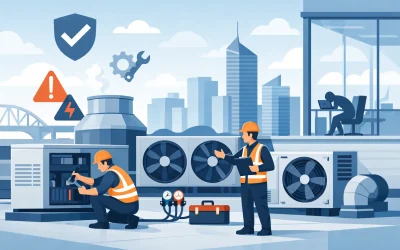
The most common HVAC-related items include fire dampers and smoke dampers inside ductwork, mechanical air handling systems that must shut down on alarm, smoke exhaust systems, zone pressurisation systems, stair pressurisation systems, and controls or interfaces that trigger the right response during a fire event.
In a simple commercial tenancy, the AS1851 scope may be fairly narrow. In a hospital, aged care site, school, high-rise or large mixed-use property, the mechanical fire safety scope can be much broader. That is where compliance becomes more technical, because system interaction matters as much as individual component condition.
What AS1851 HVAC compliance usually involves
The core of compliance is routine servicing at set intervals. Those intervals depend on the asset type and its role within the building. Some items require more frequent inspection and testing than others.
In practice, that often includes visual inspections, operational testing, verifying actuator function, checking access panels, confirming dampers open or close correctly, validating shutdown and control sequences, and recording defects or impairments. Just as important is the paperwork. If the work is done but not documented properly, from a compliance point of view you may still have a problem.
The standard expects a clear service record. That can include test dates, results, actions taken, defects found, outstanding repairs and confirmation of whether the system remains fit for purpose. In larger buildings, poor records are one of the most common weak points.
What is AS1851 HVAC compliance versus general HVAC maintenance?
This is where people often get caught out. General HVAC maintenance is aimed at performance, efficiency and reliability. AS1851 compliance is aimed at life safety performance and statutory accountability.
There is overlap, but they are not interchangeable. For example, a technician may service an air handling unit, replace filters and check motor operation. That keeps the unit running well. But if that same unit is required to shut down on a fire alarm, the AS1851 side also needs the fire-related response tested and recorded.
The same goes for dampers. A ducted system may appear to work normally for heating and cooling, yet a hidden fire damper can still be obstructed, inaccessible or inoperable. Standard comfort-based servicing will not always pick that up unless the maintenance scope specifically includes compliance testing.
Who is responsible?
Responsibility depends on the building type, lease structure and who controls the asset. In many cases, the building owner or person in control of the premises carries the main responsibility for maintaining essential safety measures. Facility managers often coordinate the work, but the legal and practical risk does not disappear just because a contractor has been engaged.
That is why clarity matters. You need to know which systems fall under the building’s fire safety strategy, who is testing them, how often they are being tested, and where the records are stored. If a site has had upgrades, tenancy changes or plant replacements over time, the compliance picture can get messy quickly.
Common issues that lead to non-compliance
A lot of AS1851 problems are not dramatic failures. They are everyday management gaps that build up over time.
One common issue is poor asset visibility. Sites often have fire and smoke dampers hidden above ceilings or inside risers, with incomplete registers or missing identification. Another is access. If a damper cannot be safely reached, it usually cannot be properly serviced. Control interfaces are another trouble spot, especially where multiple trades have worked on a building over the years and no one has checked that all sequences still operate as designed.
Then there is documentation. Missing records, vague test notes and no clear defect trail make compliance hard to defend. Even where systems are mostly functional, weak record-keeping can leave owners exposed.
How to approach AS1851 HVAC compliance properly
Start with the scope, not the tools. Before anyone talks about servicing frequency or quoting maintenance, you need to identify which HVAC assets actually sit within the AS1851 framework. That may require reviewing fire drawings, mechanical schedules, previous service records and the building’s essential safety measures documentation.
From there, build an asset register that matches the real site conditions. If it is not on the register, it is easy to miss. If the register is wrong, the servicing program will be wrong as well.
Next comes routine testing and maintenance carried out by people who understand both HVAC systems and their fire safety function. That matters because compliance work is not just a box-ticking exercise. If a shutdown fault, damper defect or pressurisation issue is found, the person on site needs to recognise what it means and what to do next.
Finally, keep the records in order. Good documentation should make it easy to answer simple questions: what was tested, when, what failed, what was repaired and what remains outstanding.
It depends on the building
There is no single answer that fits every site. A suburban office with a modest ducted system has very different compliance needs from a large education campus or an aged care facility with complex smoke control requirements.
Older buildings can be trickier again. Drawings may be outdated, equipment may have been altered, and access points may not reflect current servicing needs. In those cases, getting compliant can take more than just booking routine maintenance. It may involve audits, defect rectification, control reviews or staged upgrades.
That is also why the cheapest maintenance quote is not always the best decision. If the scope is too light, you may save money in the short term while carrying more risk than you realise.
What good compliance support looks like
Good support is practical. It should give you a clear picture of your HVAC-related fire safety assets, a realistic maintenance schedule, transparent reporting and straight answers when defects are found. You want a contractor who can separate routine wear-and-tear issues from genuine compliance risks and help prioritise what needs action first.
For Brisbane property owners and facility teams, local support also matters. Fast response, familiarity with commercial sites and the ability to coordinate maintenance with minimal disruption can make a big difference, especially where buildings operate across long hours or cannot afford downtime.
AS1851 HVAC compliance is not about overcomplicating your air conditioning. It is about making sure the systems connected to fire and smoke safety have been checked properly, maintained on schedule and backed by records that stand up when someone asks for proof. If you are not fully sure where your site stands, that is usually the right time to get it reviewed before a defect, audit or emergency does it for you.