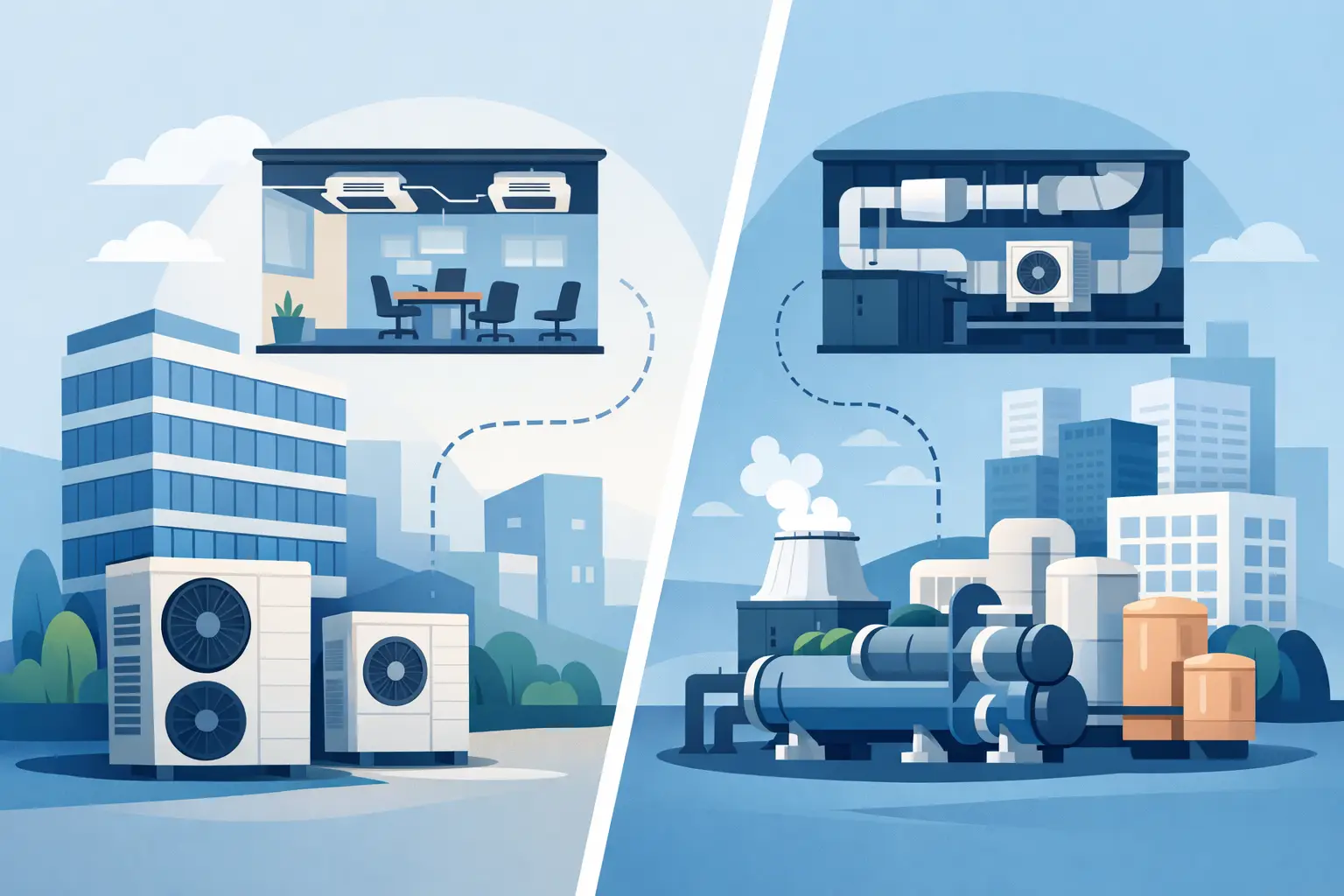
If you are weighing up VRF versus central plant systems, you are usually not choosing between two bits of equipment. You are choosing how your building will be cooled, heated, controlled and maintained for years. That decision affects comfort, energy use, plant space, future upgrades and how painful breakdowns become when the weather turns hard.
For Brisbane and wider Queensland conditions, there is no one-size-fits-all answer. A school, office fit-out, aged care site and apartment building can all land on different outcomes for good reason. The right choice comes down to building size, occupancy patterns, redundancy needs, budget and how much control you want at room level.
VRF versus central plant systems: what is the real difference?
A VRF system, also called VRV by some manufacturers, uses refrigerant as the cooling and heating medium. It connects one or more outdoor units to multiple indoor units and varies refrigerant flow to match demand across different zones. That gives you fine control and makes VRF a strong option for buildings with lots of separate rooms or tenancies.
A central plant system is broader. In commercial settings, it usually means larger plant such as chillers, cooling towers, boilers or packaged mechanical plant serving air handling units and fan coil units across the building. Instead of refrigerant running through a large network to every occupied space, you are often moving chilled water or conditioned air through the building.
That difference matters because it changes almost everything – installation method, service access, energy profile, fault impact and long-term flexibility.
Where VRF makes sense
VRF is often a good fit when you need strong zoning and the building has a lot of spaces used in different ways throughout the day. Offices with meeting rooms, medical suites, boutique hotels, townhouse developments and mixed-use fit-outs often suit VRF because each area can be controlled independently without conditioning the whole building at once.
From an installation point of view, VRF can also be attractive where plant space is limited. Outdoor units can often be placed on roofs, balconies or service areas without the large plantroom footprint central systems may require. For refurbishments, that can be a major advantage. If you are upgrading an older building and you do not have room for major hydronic infrastructure, VRF may be far easier to deliver.
Efficiency is another reason people look at VRF. At part load, many VRF systems perform well because they can ramp capacity up and down as zones call for conditioning. In buildings that rarely run at full demand all day, that can translate to lower operating costs.
The trade-off is that VRF is not automatically the best option just because it is flexible. Refrigerant pipe design, branch controllers, pipe length limits, manufacturer rules and commissioning quality all matter. A poor design can turn a good product into a problem job.
VRF strengths in practical terms
The biggest strength of VRF is control. If one tenancy wants 22 degrees and the next wants 24, the system can generally accommodate that with less fuss than a simpler central setup. Heat recovery VRF can go a step further by allowing some zones to cool while others heat, which can improve efficiency in buildings with varied loads.
For staged developments, VRF can also be easier to expand in some cases. If a fit-out changes or a floor is reconfigured, there may be a practical path to altering indoor units and controls without redesigning a whole central plant strategy.
Where central plant still wins
Central plant remains the right answer for many larger or more complex facilities. If you are dealing with a hospital-style environment, major education building, large shopping precinct, high-occupancy facility or multi-storey commercial asset, central plant often gives better whole-of-building performance and serviceability.
One reason is scale. Once a building gets large enough, central plant can be more efficient and more economical over the life of the asset. Chilled water systems, properly designed and maintained, are proven performers for big loads and long operating hours. They also suit buildings that need close integration with outside air treatment, building management systems and broader compliance requirements.
Another reason is maintainability. With central plant, major equipment is generally concentrated in plantrooms or on rooftops in dedicated service areas. That can make planned maintenance safer and more controlled. In contrast, a VRF site may have many indoor units, controllers and refrigerant components spread across occupied spaces, ceilings and risers.
When redundancy is critical, central plant can also offer stronger options. A well-designed plant can include duty-standby arrangements, multiple chillers, pumps and staged capacity so one fault does not cripple the whole building. That matters in aged care, healthcare, data-sensitive environments and sites where downtime becomes a business risk very quickly.
Central plant strengths in practical terms
Central plant gives you more room to engineer around the building rather than around packaged system limits. That is useful where ventilation requirements are heavy, where humidity control matters, or where the owner wants a long-term asset strategy instead of the lowest first cost.
It is also often the better fit when a building already has central infrastructure. Replacing or upgrading plant while retaining usable pipework, pumps or airside components can be more sensible than stripping everything out and forcing a different system type into the building.
Cost is not just the install price
This is where a lot of projects go sideways. Someone compares headline capital cost only, then gets stung later by maintenance burden, poor controllability or higher-than-expected power bills.
VRF can come in competitively on projects where installation access is tight and zoning is important. Less plantroom requirement and less heavy hydronic infrastructure can reduce upfront complexity. But lifecycle cost still depends on run hours, system layout, spare parts access and how easy the system will be to service over time.
Central plant can cost more upfront, especially where major plant, controls and distribution systems are involved. But in the right building, that higher capital spend can pay back through longevity, efficiency at scale and better resilience. For owners holding an asset long term, that matters more than shaving the initial number.
The right question is not which system is cheaper. It is which system gives the best value for this building over the next 10 to 20 years.
Maintenance, faults and downtime
Every HVAC system needs maintenance. The difference is how that maintenance is spread across the asset and what happens when things fail.
VRF systems have a lot of moving parts across many zones. That gives flexibility, but it also means more indoor units, more controls, more sensors and a refrigerant network that has to stay within specification. Fault-finding can be straightforward with the right support, but neglected maintenance tends to show up as nuisance faults, capacity issues or comfort complaints.
Central plant maintenance is usually more structured and plant-focused. You are looking at chillers, pumps, valves, towers, controls and airside equipment that support the broader system. The maintenance scope can be more specialised, but it is often easier to manage under a formal preventative programme because the core equipment is centralised.
For facility managers, the real issue is fault impact. If one VRF indoor unit fails, the problem may be localised. If a major plant item in a central system fails without backup, the impact can be wide. That is why design for redundancy and service response planning matter as much as equipment selection.
What suits Brisbane conditions?
In South East Queensland, long cooling seasons, humidity and heavy summer demand all need to be factored in. Buildings with strong solar load, variable occupancy and tenancy control needs often lean towards VRF. Larger facilities with central ventilation demands, long operating hours and strict performance requirements often lean towards central plant.
Humidity control is worth paying attention to. Sensible temperature control is only part of comfort in Brisbane. If the building use demands tighter moisture control, that should be addressed early in design, because not every system approach handles latent load the same way.
This is also where local service capability matters. A system is only as good as the team maintaining it. In practice, the best-performing setup is usually the one that suits the building and has a clear maintenance strategy behind it.
How to choose between VRF and central plant
Start with the building use, not the brochure. Ask how many zones you need, how often those zones operate differently, what your ventilation obligations are, how much plant space you have and what downtime would cost if the system fails on a 34-degree day.
Then look at ownership intent. If this is a long-hold commercial asset, lifecycle cost, redundancy and maintainability deserve more weight. If it is a fit-out with tight space and a need for tenant-level control, VRF may be the more practical path.
Good HVAC selection is not about chasing trends. It is about matching the system to the real operating conditions. That is the approach Big Dog Mechanical takes across both VRF and central plant work – assess the building properly, be honest about trade-offs and recommend the option that will stand up in the real world.
If you are deciding between the two, the smartest move is to treat the choice as an asset decision, not just an install decision. Get the design right early, and the building will thank you every summer after.