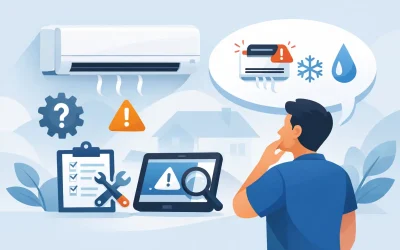
An aircon error code appearing in the middle of a Brisbane heatwave is more than an inconvenience. It can mean a simple airflow issue, a communication fault between units, or a problem that needs a licensed technician before it causes further damage. Knowing how to troubleshoot aircon error codes helps you respond calmly, protect the system and give your technician useful information from the start.
The key is to avoid guessing. Error codes are not universal: an E5 on one brand can mean something entirely different on another. Always treat the code as a clue, not a complete diagnosis.
How to troubleshoot aircon error codes before calling for repair
Start by recording exactly what you can see. Take a clear photo of the display, including any flashing lights on the indoor or outdoor unit. Note the air conditioner brand, model number, when the code appeared, whether the unit is cooling or heating, and any unusual symptoms such as water leaks, ice, rattling, burning smells or repeated shut-downs.
For a home split system, the model number is commonly located behind the front cover of the indoor unit or on a label on the outdoor condenser. In a commercial building, it may be listed in the site asset register or on an equipment label. This information matters because technicians use the manufacturer-specific code list alongside the system’s symptoms and test readings.
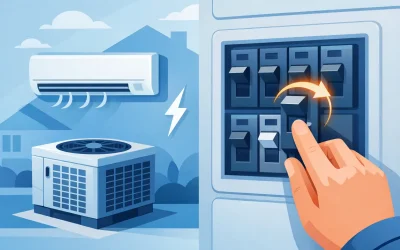
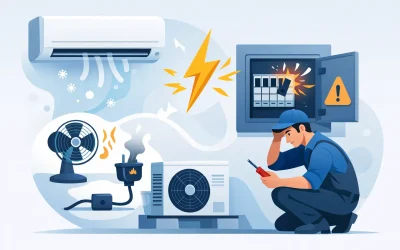
Before resetting anything, check whether the fault is creating a safety risk. Turn the system off at the controller and isolate power at the switchboard if you notice a burning smell, smoke, sparking, a tripped circuit breaker, damaged wiring, water near electrical components or a loud mechanical noise. Do not restart it to see if it clears. That can turn a manageable repair into a damaged compressor, control board or electrical fault.
If there are no safety concerns, work through these practical checks:
- Check the controller settings. Confirm the unit is set to cooling or heating as required, the temperature setting is sensible, and no timer, sleep mode or central building control setting is overriding it. A flat remote battery can also produce confusing behaviour.
- Inspect and clean accessible filters. Dirty filters restrict airflow and can contribute to freezing, high-pressure faults and poor performance. Turn the unit off, remove washable filters as directed by the manufacturer, clean them with lukewarm water and allow them to dry fully before refitting.
- Look for blocked airflow. Ensure indoor supply and return grilles are open and clear of furniture, curtains, stored stock or dust build-up. Outside, remove leaves and loose debris around the condenser. Do not hose the unit, remove panels or push objects through the coil fins.
- Check the obvious power supply points. If the system is completely dead, check the wall isolator and switchboard. A breaker that trips once may be worth resetting only if there is no burning smell, visible damage or water issue. If it trips again, leave it off and arrange service.
- Perform one controlled reset. Turn the air conditioner off at its isolator or circuit breaker for five to ten minutes, then restore power and restart it. Some temporary communication or control faults clear after a proper reset. If the error returns, do not keep cycling the power.
A reset is useful when a brief voltage fluctuation or controller glitch has interrupted operation. It is not a repair for refrigerant leaks, fan motor faults, sensor failures or electrical issues. Repeated resets can also erase the pattern that helps identify an intermittent problem.
What common aircon error code groups usually mean
The exact wording and code number depend on the manufacturer, but most faults sit within a handful of categories. Understanding the category helps you decide whether basic checks are appropriate or whether the unit should remain off.
Airflow and temperature faults
Codes related to evaporator temperature, overheating, freezing or high pressure can stem from blocked filters, obstructed coils, failed fans or incorrect refrigerant charge. Cleaning accessible filters and clearing external debris is reasonable. Diagnosing sensors, pressures and refrigerant circuits is not a DIY job.
A unit that is blowing weak air, producing little cooling or developing ice should be switched off rather than left to struggle. Continuing to run a frozen system can place unnecessary strain on the compressor.
Indoor-to-outdoor communication faults
Many split, ducted and VRV/VRF systems rely on communication wiring between the indoor unit, outdoor unit and controllers. A communication error can result from a power interruption, wiring problem, control-board fault or issue with one unit on a larger system.
A single reset may be worth trying if the fault follows a storm or power outage. If it returns, a technician needs to test the electrical supply, wiring continuity and board operation. Do not open electrical covers or attempt to reconnect wiring yourself.
Sensor and thermistor faults
Sensors monitor air temperature, pipe temperature and operating conditions. When one reports readings outside its expected range, the system may display an error code or shut down to protect itself.
These faults can be caused by a failed sensor, damaged wiring, moisture, a control-board issue or another underlying mechanical problem. A technician can test the sensor values and determine whether replacement is actually required.
Fan motor and compressor faults
Fan, inverter, compressor and current-protection codes need prompt professional attention. These components are central to system operation and can be expensive to replace if a small fault is allowed to escalate.
If the outdoor unit is buzzing but the fan is not turning, the system is repeatedly trying to start, or the breaker trips during operation, turn it off and book a repair. Avoiding further start attempts can limit damage.
Condensate and drainage faults
Ducted and split systems can stop or display a fault when condensate drainage is blocked, a pump fails or a safety float switch detects water. You may also notice dripping from the indoor unit, staining on a ceiling or water around a ceiling cassette.
Turn the system off if water is leaking indoors. Water damage, mould growth and electrical hazards can develop quickly, particularly in commercial spaces with ceiling-mounted equipment.
When an error code needs an urgent technician
Some aircon faults can wait until normal business hours. Others should be treated as urgent, especially where a system supports people, stock, equipment or compliance requirements.
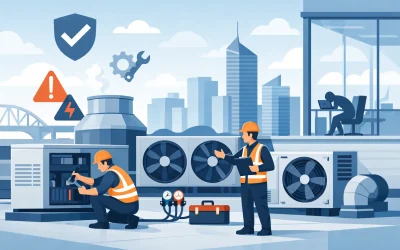
Arrange prompt support if the system has no cooling during extreme heat, repeatedly trips power, leaks water through a ceiling, displays a compressor or electrical code, makes loud noises, or serves an aged care, hospitality, education or critical commercial area. Facility managers should also act early where a fault affects several indoor units on a shared VRV/VRF system. What looks like one room problem may be linked to a larger plant issue.
For homeowners, it is worth calling before the system fails completely if cooling has weakened, the code returns after a reset, or the unit is cycling on and off. Early diagnosis is generally less disruptive than an emergency breakdown.
Big Dog Mechanical can assess residential and commercial air conditioning faults across Brisbane, from straightforward split-system errors to complex ducted, VRV/VRF and central plant issues. A qualified technician can identify whether the code is the fault itself or a symptom of something further upstream.
Prevent error codes with routine maintenance
Not every error code is preventable. Electronics can fail, storms can interrupt power and components eventually wear out. However, regular servicing reduces the faults linked to restricted airflow, dirty coils, blocked drains, loose connections and declining system performance.
For most homes, clean filters regularly and arrange professional servicing based on use, location and manufacturer recommendations. Properties near busy roads, construction activity or heavy pollen areas may need more frequent attention. Commercial systems need a planned maintenance schedule that reflects operating hours, occupancy, asset age and the consequences of downtime.
A maintenance visit should go beyond a quick filter clean. It should include checks of electrical connections, drainage, operating temperatures, refrigerant performance where required, fan operation, control functions and overall hygiene. For larger sites, asset records and fault history also make recurring code issues much easier to track.
An error code is the system asking for attention, not a reason to panic or start pulling panels apart. Record the code, complete the safe checks, reset once where appropriate and stop there if the fault returns. A fast, accurate repair begins with protecting the equipment and giving the technician a clear picture of what happened.