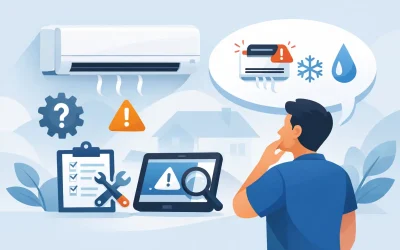
A hot Brisbane afternoon is not the time to lose power every time the air conditioner starts. If you are asking, “why does aircon trip power?”, the short answer is that the system or circuit is detecting a fault or drawing more current than it safely should. The switchboard is doing its job by cutting power before overheating, electric shock or equipment damage can occur.
The cause may be as straightforward as too many appliances on one circuit, or as technical as a failing compressor, damaged wiring or moisture inside the outdoor unit. What matters is recognising the pattern, taking the right first steps and not repeatedly resetting the breaker in the hope it will stay on.
What does it mean when an aircon trips the power?
Your air conditioner usually has protection at the switchboard through a circuit breaker, a safety switch (RCD), or both. A circuit breaker generally trips when there is too much current flowing through the circuit. A safety switch trips when it detects electricity leaking to earth, which can indicate a shock risk.
The distinction helps narrow down the problem, but homeowners and site managers should not try to diagnose electrical faults inside the unit. In Queensland, electrical repairs must be carried out by a licensed electrician. An experienced HVAC technician can assess the air conditioning equipment and coordinate the right electrical repair where required.
If the aircon trips immediately when switched on, it points to a different set of likely faults than a system that runs for 20 minutes before cutting out. Note what was happening at the time – cooling start-up, heating mode, heavy rain, or when other equipment was running. That information can save time during a service call.
Why does aircon trip power at start-up?
Air conditioners draw their highest current when motors and compressors start. A healthy system is designed for this, but a worn component or unsuitable circuit can push the current beyond the breaker’s limit.
A failing compressor or start component
The compressor is the hardest-working component in a reverse-cycle air conditioner. It pumps refrigerant around the system and requires a substantial burst of power at start-up. If it is ageing, mechanically tight or electrically compromised, it may pull excessive current and trip the breaker straight away.
Some systems also rely on capacitors or inverter control components to start and run efficiently. When these parts fail, the unit may hum, attempt to start, then trip. This is not a repair to put off. Continuing to reset the breaker can cause further damage to the compressor or control board.
Circuit overload
An overloaded circuit is common in older homes, offices and tenancies where electrical use has grown over time. The air conditioner may share a circuit with power points, kitchen appliances, IT equipment or other high-load items. When demand peaks, the breaker trips.
This is particularly relevant for a replacement air conditioner that is larger than the previous unit, or for commercial spaces where additional equipment has been added without reviewing electrical capacity. The solution may involve a dedicated circuit, cable upgrade, breaker assessment or a more appropriate system design. It depends on the building’s supply and the unit’s electrical requirements.
Incorrect breaker sizing or electrical installation issues
A breaker that is too small can trip under normal operation. A breaker that is too large is not a safe workaround – it may fail to protect the cable and equipment properly. Loose connections, undersized cabling and poor previous installation work can also create heat and intermittent tripping.
These issues need proper testing, not guesswork. A technician should check the system’s rated current, actual operating current, cable condition and circuit protection before recommending changes.
Why does the air conditioner trip after running for a while?
A unit that starts normally but trips later often has a fault that develops as parts warm up, as the system works harder, or when water and condensation build up.
Dirty filters and restricted airflow
A blocked filter will not always trip power on its own, but it can trigger a chain of problems. Restricted airflow makes the indoor fan and refrigeration system work harder. Coils can become dirty, temperatures can rise or fall outside normal limits, and the compressor may run under unnecessary strain.
For a ducted system, blocked return-air filters, crushed ductwork or closed-off zones can produce similar symptoms. In commercial sites, neglected filters can also affect indoor air quality and increase energy use long before a breakdown occurs.
Cleaning accessible filters is a sensible first check, provided the unit is switched off at the isolator. If the problem continues after cleaning, arrange a service rather than removing covers or attempting internal repairs.
Faulty fan motor or capacitor
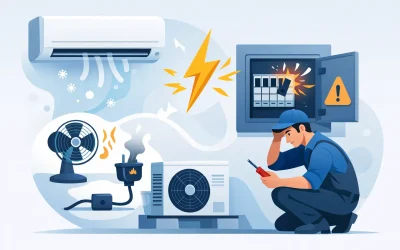
Indoor and outdoor fans remove heat and keep air moving across the coils. A fan motor with worn bearings, damaged windings or a failed capacitor can draw excessive current, especially once it gets hot. You may notice weak airflow, unusual noise, a burning smell, or an outdoor fan that starts and stops before the power trips.
Fan faults should be addressed early. Without proper airflow, a relatively small component fault can place expensive strain on the compressor.
Refrigeration faults and frozen coils
Low refrigerant charge, a refrigerant leak, dirty coils or restricted airflow can cause the evaporator coil to ice up. Once airflow is reduced further, the system may overwork and shut down. While an iced coil does not automatically mean an electrical fault, it can contribute to abnormal operation and tripping.
Do not treat refrigerant as a DIY top-up. Refrigerant work requires licensed handling, and simply adding gas without finding the leak will not fix the underlying issue.
Water, moisture and weather exposure
Queensland humidity and summer storms can expose weaknesses in outdoor electrical connections, isolators, control boards and cable insulation. If the safety switch trips during or after heavy rain, moisture ingress is a real possibility.
Turn the air conditioner off and leave it off until it has been inspected. Water-related electrical faults can be intermittent, so a system that appears to work again once it dries out may still need attention. The same applies to water leaks around indoor units, where blocked condensate drains can affect nearby electrical components.
Safe checks before you call for help
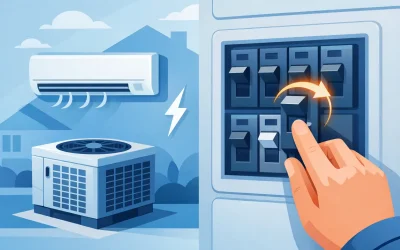
There are a few safe observations you can make without opening the air conditioner or switchboard. First, turn the aircon off at its controller and isolator if accessible. Reset the tripped breaker or safety switch once. If it stays on, wait a few minutes, then try the system again.
If it trips again, stop there. Repeated resets can turn a manageable fault into a larger repair and may create a safety risk. Take note of whether the whole property lost power or only the aircon circuit, whether the trip occurred on cooling or heating, and whether there were noises, smells, water leaks or visible ice.
For workplaces, it is also worth checking whether the outage affected critical areas such as server rooms, treatment rooms, food storage, classrooms or occupied accommodation. This helps prioritise the response and put temporary measures in place.
When an aircon power trip needs urgent attention
Arrange prompt professional support if the safety switch will not reset, the unit trips immediately every time, there is a burning smell, sparking, smoke, buzzing from the switchboard, or signs of damaged wiring. Turn off the air conditioner and avoid using it until it is checked.
For commercial properties, recurring trips should be treated as an operational issue rather than an inconvenience. A failing air conditioner can disrupt tenants, staff and customers, while repeated electrical faults can lead to avoidable downtime. Preventative maintenance helps identify high current draw, deteriorating electrical connections, blocked coils and worn components before they cause an outage.
Big Dog Mechanical supports Brisbane homes and businesses with air conditioning fault-finding, repairs and planned maintenance across split systems, ducted units and more complex commercial HVAC equipment. The aim is not just to get the power back on, but to identify why it tripped and reduce the chance of the same fault returning on the next hot day.
A breaker that trips once may be a warning. A breaker that trips repeatedly is a clear request for attention. Switch the system off, protect the property and have the fault properly assessed before the next heatwave puts the air conditioner under load again.