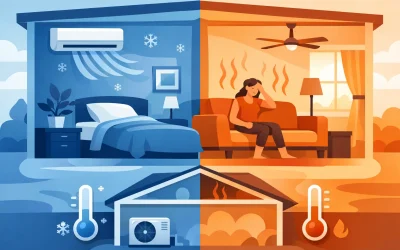
When a classroom is too hot, too humid or stuffy by mid-morning, learning drops off fast. That is why the best HVAC solutions for schools are not just about cooling a building. They are about keeping students focused, protecting staff comfort, managing running costs and making sure the system holds up under daily use.
Schools put different pressure on HVAC systems than most other buildings. Occupancy changes by the hour. Some rooms fill with thirty students, while others sit empty for periods. Libraries, halls, admin offices, science rooms and staff areas all have different load demands. Add Queensland heat, humidity and the need for reliable ventilation, and there is no single system that suits every campus.
What the best HVAC solutions for schools need to deliver
A school HVAC system has to do more than reach a set temperature. It needs to control humidity, bring in enough fresh air, filter contaminants and stay dependable during peak demand. It also needs to do that without pushing power bills through the roof or creating constant maintenance headaches.
That is where many school projects go off track. The cheapest install is rarely the cheapest system to own. If equipment is undersized, poorly zoned or difficult to service, the school pays for it later through complaints, breakdowns and rising energy use. A better result usually comes from matching the system to the way the school actually operates.
In practical terms, that means looking at classroom density, building orientation, insulation, usage patterns, existing electrical capacity and the age of the site. Newer buildings may suit more advanced control strategies. Older campuses often need staged upgrades, not a full replacement in one hit.
Best HVAC solutions for schools by building type
Split systems for smaller standalone spaces
Split systems can be a strong option for single classrooms, demountables, admin offices and small learning spaces. They are relatively straightforward to install, cost-effective upfront and easy to replace in stages when budgets are tight.
The trade-off is that managing a large number of separate units across a campus can become inefficient. Maintenance is more fragmented, controls are less centralised and visual impact can be an issue. For a small school or a targeted upgrade program, split systems can work well. For larger campuses, they are often only part of the answer.
Ducted systems for controlled comfort in defined areas
Ducted air conditioning suits schools that want more even airflow and a cleaner finish across a defined area such as administration blocks, libraries or dedicated learning centres. With proper zoning, ducted systems can improve comfort and help avoid the hot and cold spots that often come with poor layout planning.
The key is design quality. If duct sizing, outlet placement or return air paths are wrong, comfort suffers. In school settings, ducted systems also need to be easy to access for servicing and filter changes. Hidden plant that is difficult to maintain tends to become expensive plant.
VRV and VRF systems for larger or more complex campuses
For multi-room buildings with varied occupancy, VRV and VRF systems are often among the best HVAC solutions for schools. They allow precise zoning, better control across different areas and strong energy performance when designed properly.
This matters on campuses where one block may be in full use while another is only partly occupied. Instead of conditioning everything the same way, the system can respond to actual demand. That can improve comfort and reduce wasted energy. The upfront cost is higher than simpler systems, but for many education sites the operational benefits justify it.
Central plant for major facilities
Larger schools, colleges and education campuses may be better served by central plant systems. These can handle substantial loads across multiple buildings or large common areas and may be the right fit where long-term asset planning is the priority.
That said, central plant is not automatically the best choice just because a site is large. It requires proper maintenance planning, competent controls and a realistic budget for lifecycle costs. Without that, a sophisticated system can quickly become a reliability problem.
Ventilation and indoor air quality are not optional
Temperature complaints get attention first, but ventilation and air quality often have a bigger effect on how a classroom feels. A room can be cool and still feel stale if outside air is inadequate or humidity is too high.
Good school HVAC design accounts for fresh air requirements, filtration and moisture control from the start. This is especially important in high-occupancy spaces, older buildings and rooms that stay closed for long periods. If air movement is poor, students and staff notice it quickly, even if they cannot point to the exact problem.
In Queensland conditions, humidity control deserves extra attention. If the system cools without properly managing moisture, classrooms can feel clammy and mould risk increases. That affects comfort, presentation and maintenance costs. Schools should be looking for systems that do more than blast cold air.
Controls matter more than most schools expect
A well-built system can still perform badly if the controls are clunky, inaccurate or ignored. Schools benefit from simple, practical controls that staff can use without needing specialist training.
The right setup depends on the site. Some schools need central oversight so facilities teams can monitor multiple areas and adjust schedules. Others are better off with straightforward local control backed by lockouts or programmed operating windows. The point is to avoid systems that are either too basic for the building or too complicated for the people using them.
Good controls also help with energy use. Timers, zoning and occupancy-based scheduling can cut waste without affecting comfort. If classrooms are being conditioned when nobody is there, that is money walking out the door.
Maintenance is part of the solution, not an afterthought
One of the most overlooked parts of choosing the best HVAC solutions for schools is maintenance access. If filters are hard to reach, if condensate drains are neglected or if key components cannot be inspected easily, small issues turn into expensive ones.
Schools need preventative maintenance programs that fit around term schedules and minimise disruption. That includes servicing, hygiene cleaning, asset tracking and early identification of wear before it becomes a breakdown. For busy education sites, reactive repairs alone are not enough.
There is also a compliance angle. Schools have a duty to provide safe, usable environments for students, staff and visitors. Poorly maintained HVAC systems can contribute to air quality issues, water leaks and unreliable performance at the worst possible time.
Budget, staging and upgrade strategy
Most schools are balancing performance needs against fixed budgets. That is normal. The answer is not always a full replacement. In many cases, staged upgrades are the smarter move.
A sensible plan might begin with an asset audit to identify which units are near end of life, which spaces have the highest complaint rates and where energy use is out of proportion. From there, schools can prioritise high-impact areas and spread capital works over time.
This approach also reduces risk. Rather than replacing everything at once and hoping the design is right, a staged program allows schools to improve performance in practical steps. It is often the best path for older Brisbane-area campuses where infrastructure has evolved over decades rather than following one clean design.
What to look for in an HVAC partner for schools
Schools need more than installers. They need a contractor who understands live environments, can work safely around students and staff, and can provide support long after commissioning.
That means clear advice, realistic recommendations and the technical range to handle everything from split systems to larger commercial plant. It also means being responsive when something goes wrong. In education settings, downtime is not just inconvenient. It disrupts teaching and administration straight away.
For schools across Brisbane and surrounding areas, local support matters as well. Fast response, practical maintenance planning and technicians who understand the climate all make a difference over the life of the system. That is the sort of work Big Dog Mechanical is built around.
The right HVAC solution for a school is the one that matches the building, the people using it and the budget available to maintain it properly. If a system keeps classrooms comfortable, controls humidity, supports air quality and stays reliable through the school year, it is doing its job. That is the standard worth aiming for.